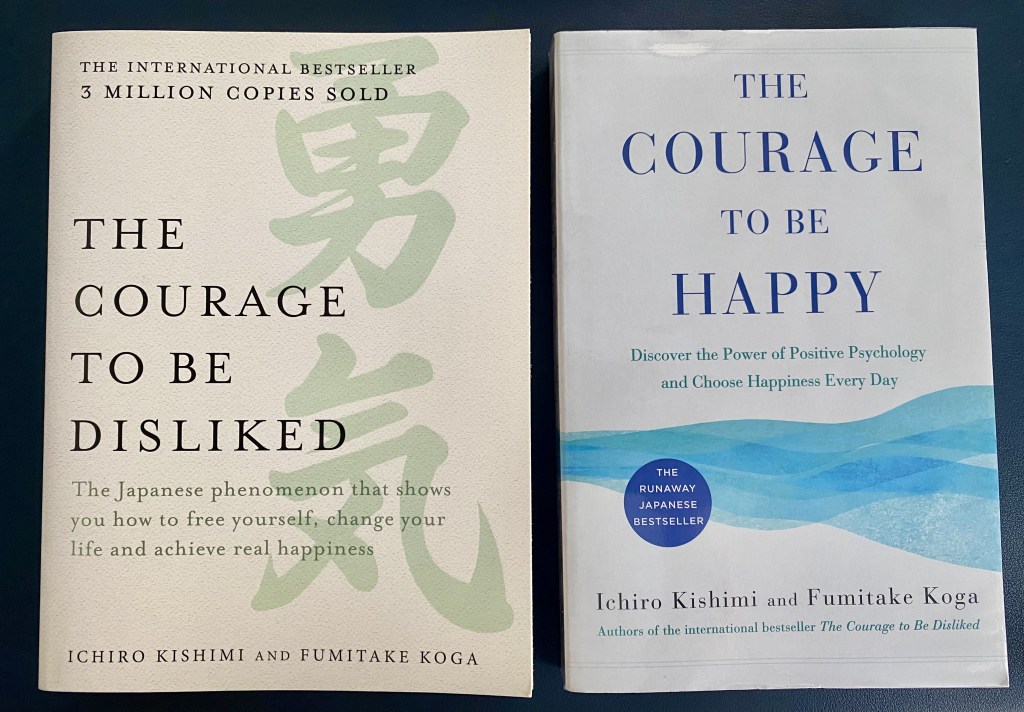
I came across the 2 titles, “The Courage to be Disliked” and “The Courage to be Happy” by Fumitake Koga and Ichiro Kishimi while looking for avenues to learn more of my situation. These 2 titles brought on so much similarities of myself with the youth – doubtful, questioning, angry, unsatisfied and a sense of inferiority complex.
This was not my first attempt to read a self-help book to deal with my emotions and understand why, but this resonated the most right from the onset. Fumitake Koga-san and Ichiro Kishimi-san did a great job by portraying the conversations a doubtful youth with a wise philosopher, questioning the Alfred Adler’s individual psychology. I love how the Kishimi-san summarised the production of the book as “the exceptional powers of understanding of Koga” and how “the youth in this book could be either of us, but more than anyone, he is you”.
Because it is exactly that, through conversations that we learn the different perspectives.
I want to take this opportunity to share my takeaways and reflections from these 2 books, and perhaps play some parts of the youth in questioning.
The Courage to be Disliked
“Free of the shackles of past experiences, doubts and the expectations of others“
This phrase made me picked up this book. I was constantly struggling to be a people pleaser and I felt parts of me being ripped off day by day to a point where I am almost disgusted to be around anyone. I just wanted to stay within the walls of my home, look outside the window and do nothing.
I was exhausted.
Perhaps I was not a strong communicator and wanted to do a lot of the things myself. And of course, I was constantly placed into a discussion of personal contribution for the past few years.
The First Night felt like a real hard bitter medicine to swallow where the youth discussed how his friend wanted to leave the room but was told he did not wanted to in the first place with the reason of getting attention or being different. The main ideas in The First Night are that of “lifestyle”, “decision” and “courage to change”.
“Lifestyle is the tendencies of thought and action in life”
If one changes his/her lifestyle, he/she changes the way of interaction with the world. However, the idea of changing one’s lifestyle is easier said than done for most, because of the anxieties, inconveniences and difficulties.
I hear myself shouting at the top of my lungs like that of the youth, who cried out about how his friend really wanted to change but could not. What were the anxieties, inconveniences and difficulties I am facing? What should I start prioritising? What actions should I take?
The Second Night continues with the youth’s plea to learn more, discussed more of his inferiority complex – “I could see no reason why I’d start liking myself” and the chapter summed up with the discussion that all problems, be it from self or with others, stemmed from “interpersonal relationship problems”.
“To get rid of one’s problems, all one can do is live in the universe all alone” – Alfred Adler
I felt this was so targeted to myself as I was weak in interpersonal relationships, perhaps seeing people as enemies rather than comrades. I noticed that even at work, started from the point where I had to take on the huge task of meeting the a region’s numbers, that I became so entrenched in pushing others away, thinking that they are out to force my hand in disclosures and/or to leave (although most cases actually turned out to be true!). While I have tried to make an enemy a friend, it seldom made progress because I might have already determined their motives as hostile, or a “life-lie” with the “goal of taking a dislike” before.
How can I not make this mistake or move out of this downward spiral?
This brought us to The Third Night where one should avoid or “deny the desire for recognition” and gain “real freedom”. We need to learn how to “separate tasks”. This is also where I faced the arguments brought up by the youth, where he discussed about how one’s born to seek recognition, and even at workplaces, leaders are asked to give recognition to their team or employees, and how tasks in life are interconnected. But it makes total sense because I felt agony when I needed to fulfil the expectations of others, and I believe this is the gist of the whole book.
“Do not live to satisfy the expectations of others”
Now that got me thinking too – could the use of recognition then be a contrarian way that make employees unhappy in the first place? If we do not seek recognition, does that mean the power of management is reduced? And what is made of them to push people for performance? Are these acts of “leaders” or “managers”?
Regardless, I dived further into the topic of recognition, rewards and punishment. Found this interesting article by Audrey Watters about how pigeons were “trained” with rewards back in the days or WWII, by a psychologist named B.F. Skinner.
Skinner was known to research into behavioural psychology, more so on effective control and he believed that freedom is a myth which prohibited the advancement of behavioural science that “can better organise and optimise society”.
“Why is it that people seek recognition from others? In most cases, it is due to the influence of reward-and-punishment education”… “You are worried about being judged by other people. That is why you are constantly craving recognition from others”
I looked inwards: “how do I feel when I get recognised or when I do not?”
In the case of being in a revenue generating role, in a business leader role, this is almost always valid because we need to bring results to justify presence or employment. Being judged with rewards-punishment is like an everyday task no matter how well one does. Being placed in the spotlight means one has to constantly be at peak performance, managing and juggling things, and with technology, one’s almost always reachable for information or updates.
So the need to get “friendly” is almost always there. So how does one recognise the need to be liked or one to be disliked? The idea shared is to first recognise one cannot satisfy everyone as there will be people who dislike you, no matter what.
“Freedom is being disliked by other people”
Kishimi-san and Koga-san discussed how each of us generally approach relationships, be it between 2 parties or with a large group. But one seldom look at the relationship with self.
“When one is tied to the desire for recognition, the interpersonal relationship cards will always stay in the hands of other people”
While The Third Night discussed on how to gain freedom and control by starting with amending the relationship with self, and having courage to not need recognition from others, the Fourth Night elevated the discussion towards community and concern for others in order to gain happiness. This is where I also experienced the “huh?” moment just like the youth in the book.
To start off, the authors described a self-centred person – one who is “incapable of carrying out the separation of tasks and who are obsessed with the desire for recognition”. We cannot control what others think, do or feel about us and to take oneself out of the centre, one can then feel as part of a community to give and contribute. And in the definition of a community, it is discussed as one that is not absolute, meaning a community larger than what we perceive as work, family or school, rather one of the earth or universe.
“One needs to think not what will this person give me? but rather, what can I give to this person? This is the commitment to the community”
I can see why it is much harder to comprehend because of the proximity of our relationships are typically closer than we thought. And with the recognition system in place, we are constantly assessed by how these relationships are. The authors then explained further into why we should look into a wider terminology of community and how it is related to interpersonal relationship.
The example provided was one of an authoritarian teacher, or even one holds a higher power in the school or workplace. Most often, we see the need to satisfy this figure if we have limited the scope of community. But if one sees a wider community, one sees the interpersonal relationship with that, and not the authoritarian figure. So there is no need to “cling to the small community right in front of you” or live in fear of this relationship failing.
Like the youth in the book, the first thought that came was “how can I do that when my contribution is limited by this authoritarian figure?”.
The authors went on to further discuss the idea of “horizontal relationship” where we see each other as comrades, or partners, rather than one of “vertical relationship” that is of power and hierarchy. Rewards and punishments, praises and rebukes as forms of recognition are causing relationships of power and hierarchy. In most cases, this is unavoidable primarily caused by the current social system where there’s always a leader or a group of people honing power, and we often have to abide by these authoritarian figures to earn our keep. Perhaps hard to digest, the current societal system is unlikely to accept this as a widely adopted one because there’s hierarchy especially in Asian culture. Even more so, Asian languages such as Japanese, Korean, Chinese etc. have a hierarchy which embeds the exact presence of hierarchy into everyday lives.
But one must not forget that Adler’s psychology is one of individual psychology, which means everything starts with self. Someone has to start.
If we do not approach a relationship with rewards and punishment, how do we then progress?
“It is about having concern for others, building horizontal relationships and taking the approach of encouragement”
Adler’s psychology discussed that seeking recognition and praise is an endless cycle of judgement as good or bad, or even worse, thinking that the other party has got no ability. To break away from this cycle, one must not seek recognition or praise.
As individuals, we can express gratitude with a simple “thank you” or our feelings of delight. The feeling of encouragement is one that needs to be conjured and felt by the receiving party. For both to see that encouragement is progress, one needs to start building a relationship that stems from love and friendship, a horizontal relationship.
“Accept what is irreplaceable. Accept ‘this me’ just as it is. And have the courage to change what one can change. This is self-acceptance”.
The last chapter, The Fifth Night. discussed the idea of “self-acceptance” and dived deeper into the concept of tasks separation, by differentiating trust and confidence in building deeper relationships. This last chapter also teases the concept of “courage to be happy” and bridged that with the authors’ next book.
“Life in general has no meaning. Whatever meaning life has must be assigned to it by the individual” – Alfred Adler
Like material things in life, nothing has meaning except for the meaning you give it. The authors expanded the meaning of “now” and discussed how one should look into his/her life though connecting dots, with up and down moments, rather than a line. The importance and emphasis is on “now”, not one of invented pasts or future that one has little control of – “do not look at the past, and do not look at the future”.
“Someone has to start. Other people might not be cooperative, but that is not connected to you.”
Summary: “The Courage to be Disliked”
The book is for someone who wants to choose freedom as his/her guiding principle in life, and for some reasons, faced frustrations or confusion on how to go about it. People and society cannot be changed and if we were to rely on how they should behave or should be like, we are placing an emphasis on our self-centredness that is causing the lack of freedom.
The process and 3 biggest ideas from my point of view:
- 1. Self-Acceptance: That I am an ordinary person, nothing special, just wanting to be able to be free and happy without the need for recognition from others.
- 2. Build Horizontal Relationships: To do that, I need to see people as friends and comrades, not of power or hierarchy, but also maintaining/giving the respect and gratitude. This will help increase my value and contribute to others or the community.
- 3. Moments of “Now”: We all have a past, and are creating a future. To have freedom and happiness, focus on what’s now, live earnestly now, and the opportunity in life is now.
The Courage to be Happy
Following the teachings of the Alfred Adler, this book helped to clarify and expand on the previous title in the areas of self, recognition and contribution. Apart from these concepts, Kishimi-san and Koga-san also spent a chapter on discussing the concept of “love” in Adler’s psychology, and what it meant towards happiness.
“That Bad Person and Poor Me” starts off the title with the concept of removing oneself from the view of victimhood. It is shared that most of us want to paint a tragic story and how another party was responsible. The triangulation tactic taught here discussed “what should I do from here?” instead of clinging onto the past or events. To even get past this stage, one has to practise empathy, not sympathy. One has to give respect, by seeing them as they are, walk the same steps and have the same mind and heart. Empathy is an attitude whereas sympathy is one of agreement and feelings takes over, so it is often confused. Guilty as charged.
“We can choose new selves. Yet it is not easy to change oneself… Change is death itself”
“Why negate reward and punishment?” spent time to discuss the basis of education and the stages of problem behaviour – “demand for admiration”; “attention drawing”; “power struggles”; “revenge on you” and lastly “proof of incompetence”. The first 3 stages are where the one with problem behaviour expresses a lack of love, and the resolution is empowering others to be “self-reliant”.
“Man’s juvenile condition is not due to lack of reason. It is that he has neither the resolution nor the courage to use his reason without direction from another.” – Kant
While this chapter expands on the need to have the responsibility and courage to allow others reach their own decisions, and separating one from the task of that decision-making, this made me think if organisations are spending time with the idea of coaching as means to empower or as means to take responsibility off management. Because either way, the philosophy is a double-edged sword which can be used in favour or not. Should it be in the hands of people with power, the punishment can easily be exercised.
Optimistically speaking, it gives people the opportunity to “grow” and “mature” so they understand what’s at stake and how to reach decisions.
“From the principle of competition to the principle of cooperation” opened with how competition is an environment for “gamesmanship and unfairness” and this is where I believe we will lose most audiences especially corporates and economies. But it makes total sense where it discussed “real democracy is one without reward and punishment, and without competition”, and a community needs to run on such principles of cooperation, not competition.
“As long as the judgement criteria are unclear, the world will be rampant with people who hold their comrades back, take credit for other peoples work, and flatter their leaders so as to gain recognition only for themselves”
Adler’s psychology shared about how people are born with a “feeling of inferiority” and that made groups or communities possible. Should one choose to be isolated physically or mentally, he/she will inherently feel threatened. This is why people are social animals, longing for a connection. However, to belong in the community, one needs to understand that one is neither superior nor inferior, just ordinary.
“Having another person decide the worth of me – that is dependence. Determining the worth of “me” myself – that is self-reliance”
This is what was also discussed in earlier book – “The courage to be disliked“. Yet this chapter dived deeper into why some remains having the juvenile behaviour, which was strongly linked to the use of reward and punishment as a restraining measure. We see this being used as early as we enter education, ranking children and streaming them to classes of elites, normal or slower than normal etc. Competition is everywhere since early childhood days as parents have lesser time to spend with their children. Naturally with segregation of how well one does in class, the competition element is hard to be ignored.
Perhaps it is a good thing that countries such as Japan do not have large scale exams until the age of 10, but rather taught about respect and gentleness to animals and nature.
“Give, and it shall be given unto you” discussed how one should start by liking oneself because that is a foundation towards believing in others and embarking on interpersonal relationships. This chapter also provided expanding meaning to the word “relationships” through the synonyms of “respect” and “confidence” which expects nothing in return, rather than the commonly used word “trust” where it is one with vested interest, a condition-based relationship.
“One has confidence in other people, and one embarks on friend relationship. We cannot gain happiness solely by dedicating ourselves to our work”
In work relationships, because we are bounded by the corporate community, we have to work together whether there is preference or not. However, not all tasks are easily justified or yield results. Here, Kishimi-san and Koga-san discussed Adler’s definition in work is one of “production for staying alive in our earth’s harsh natural environments” and due to the limited resources, people need to work for their keep, to survive.
But this is also where I felt bewildered because in a world with limited resources, naturally there will be people who develop a sense of competition because they would want more, and they would want to welcome competition with a possibility of getting more. Perhaps it is how the world is perceived that there is limited resources. What if there isn’t? What if there is abundance?
The way where we can have more of cooperation is either to gather similarities in communities to capture resources, or reduce the number of communities vying for resources. The idea of giving, can be too hard for people who want more to accept, but people have enough to want to give.
“Choose a life you love” is the last chapter of this title and we see the debate started on the definition of love, whether it is one of romantic love or one that is responsibility of love, the art of loving. As both authors constantly discuss “life tasks”, the idea of love as a task is then “to accomplish a happy life”, one of building happiness of “we” rather than “me” or “you”.
“Falling in love is no different from the desire to possess, or the desire for triumph”
This is why the initial discussion of love, is not when one falls in love, but rather a decision to love. And it is not an easy task since “people are afraid of loving”, just like how people are afraid of change.
“While one is consciously afraid of not being loved, the real, though usually unconscious fear is that of loving. To love means to commit oneself without guarantee, to give oneself completely. Love is an act of faith, and whoever is of little faith is also of little love.” – Fromm
Kishimi-san and Koga-san ended the title about how everything is connected to courage, whether it is to love or to be happy. But should not abuse the word of “love” into one of hedonistic nature because that is an act of self-centredness, looking into leading an easy way of life. To love, one needs to grasp the idea of “now”, “without thinking about a future one could never comprehend, or about a destiny that could never exist”.
Summary: “The courage to be happy”
Very much like the concepts in the authors’ earlier title, this opens up a different stage of life of the youth, with further questions of Adler’s individual psychology. The youth casted doubts on whether such ideals are doable, practicable or practical in the modern world. Like the youth, I have the same line of thoughts. If I were to place a difficulty level in both the concepts shared from Kishimi-san’s and Koga-san’s titles, I would say the ones in “the courage to be happy” is lot harder to practise, a much bitter hard medicine to swallow. Even when I shared this with a close friend, the first reaction was not acceptance (at least not a rejection), but rather seeing all these as ideals, zen-like way of living. Still, I believe most are doable on our own, even though they are hard to do. Like what the authors shared, it is harder if we perceive the need to be recognised by other. From this title, these are ideas that have resonated with me:
- 1. Practise empathy: Unlike sympathy, empathy looks into a behaviour or attitude, understanding that it is “me” who needs to start doing instead of placing a punishment on self by others’ actions.
- 2. Practise a “giving” mindset: Abundance is when one has the ability to give, and in a world of “takers”, “giving” can sometimes be too taxing. Yet, this is where we will feel the joy from contribution and adding value to others. This provides confidence in oneself. Without asking anything in return, one has no inclination to be recognised by living others’ beliefs.
- 3. Develop your courage: Take the first step, have courage not fear. Understand that a task of love is one of loving, instead of seeking to be loved. Work towards giving confidence to others to build relationships of “us”. Give up the idea of “trust” as that is one of egoism.
This is probably my longest post as I’ve spent a considerable amount of time to study both titles. I expect to go read them again in the near future and if you have arrived at this end, I hope this summary gave you something to work with or towards. Thank you.








 We live, we love, we strive
Leave a reply to How I Lost and Found Myself? – We live, we love, we strive Cancel reply