
I’ve had my fair share of coaching from high school life playing sports and have also been exposed to the idea of mentorship. In both cases, they may be seemingly similar but in recent years, the idea of coaching has superseded mentorship and I have been hearing much lesser mention of mentorship.
So what’s the difference in each case? How do I know which is the one I am more inclined to?
In my recent search for self-improvement and guidance, the word “coaching” keeps showing up in my search feed. Coaching has the below definition from various bodies:
“Coaching as partnering with clients in a thought-provoking and creative process that inspires them to maximize their personal and professional potential.” – International Coaching Federation
In the corporate environment, MIT HR defined it as:
“Coaching, defined as an ongoing approach to managing people: creates a genuinely motivating climate for performance; improves the match between an employee’s actual and expected performance; increases the probability of an employee’s success by providing timely feedback, recognition, clarity and support”
In the context of mentorship, it is defined more broadly by National Institute of Health (NIH) where “Mentorship is a professional, working alliance in which individuals work together over time to support the personal and professional growth, development, and success of the relational partners through the provision of career and psychosocial support.“
And mentorship has garnered a higher focus in learning and development of employees according to a discussion by Matthew Reeves from Together.
While the words coaching and mentoring have two different meanings today, in ancient Greece, both coaching and mentoring points towards the same source – to learn from the wise.
Is there a shift from mentoring to coaching?
In this post by Coach Foundation, coaching is mentioned to have come to light in 1992 and is loosely defined as “a process of developmental learning wherein an individual is guided through the advice and suggestions of his mentor“.
And here’s here it gets more interesting where coaching “Coaching “empowers an individual by seeking help for themselves, it also enables them to take greater responsibility and accountability for their habits. A coach also gradually helps an individual to realise their innate potential by letting them make their own decisions.”
According to Reeves, mentorship started since the 1970s and has gradually evolved. While my fair share of mentorship has been limited to one of its mentioned benefits in corporates, to onboard faster, the entire benefits of mentorship were seemingly absent.
Below is a table of benefits to the organisation (credits: https://www.togetherplatform.com/blog/what-is-the-purpose-of-mentoring)
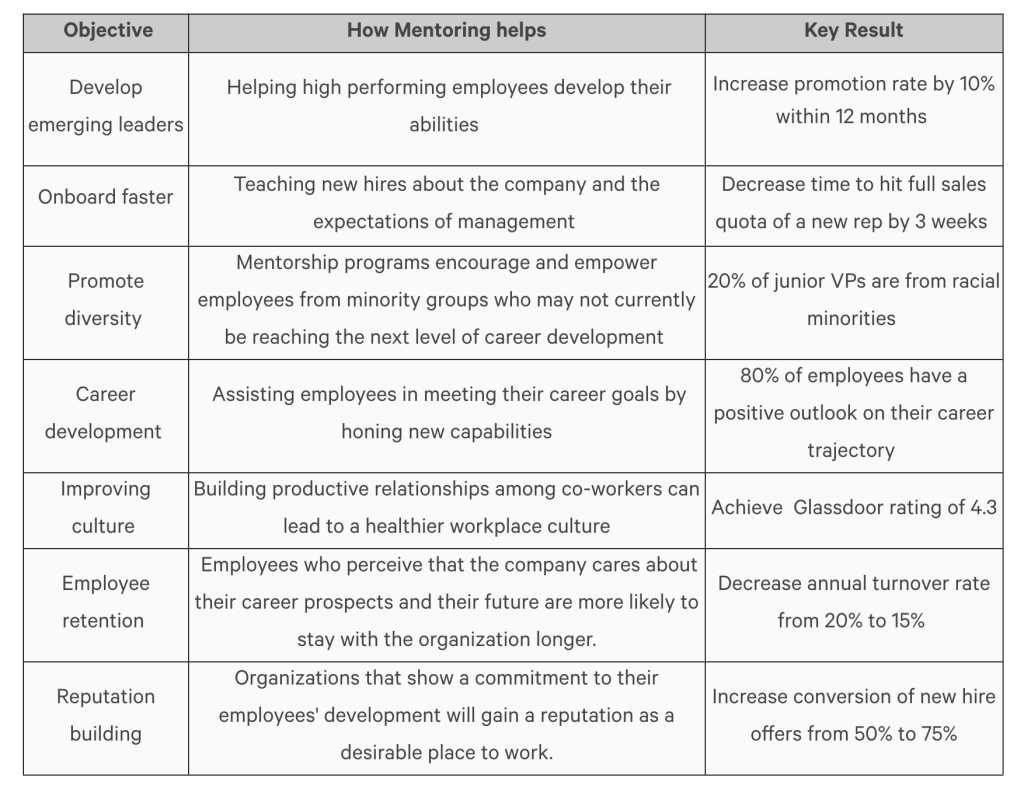
However, most organisations are much inclined to know how to enhance and stimulate employee productivity. The idea of coaching was adopted by various companies that hired psychologists to enhance the efficiency of their employees, rather than focusing on wider loop of their personal growth that will then benefit the respective organisations.
Perhaps the most prolific coach of our time, Tony Robbins, can shed some light on the interchangeable use and clarity of mentor or coach:
“A mentor is like a coach for your mind. While an athletic coach focuses on both the physical and mental pieces of the game, getting the body in top shape as well as getting the athlete in the right mindset, a mentor stays solely in the realm of the mind. The role of a mentor is to be a role model, lend you their knowledge and provide emotional support. – https://www.tonyrobbins.com/coaching/get-the-edge/
At the end of the day, what makes a good mentor is passion. Mentors aren’t paid and there’s a difference with organisational coaching because organisations do pay coaches to engage with their workforce or leadership these days, mostly getting an external, neutral view of their operations and to improve efficiency.
Internally, managers who promote themselves as coaches trying to coach their employees, are adopting the methodologies, approach or knowledge of coaching, rather than being coaches themselves. I would argue that corporates should focus on mentorship internally, sharing knowledge and guidance, to help employees’ grow and aid talent retention. Unless the organisation has an approach where they just want employees as quick fixes or that its management do not want to be accountable for work and try to make its employees accountable for any non-desired performance, the idea of co-creation in mentorship is a more responsible, knitted approach towards the growth and mental health of employees.
Don’t you agree?






 We live, we love, we strive
Leave a comment